
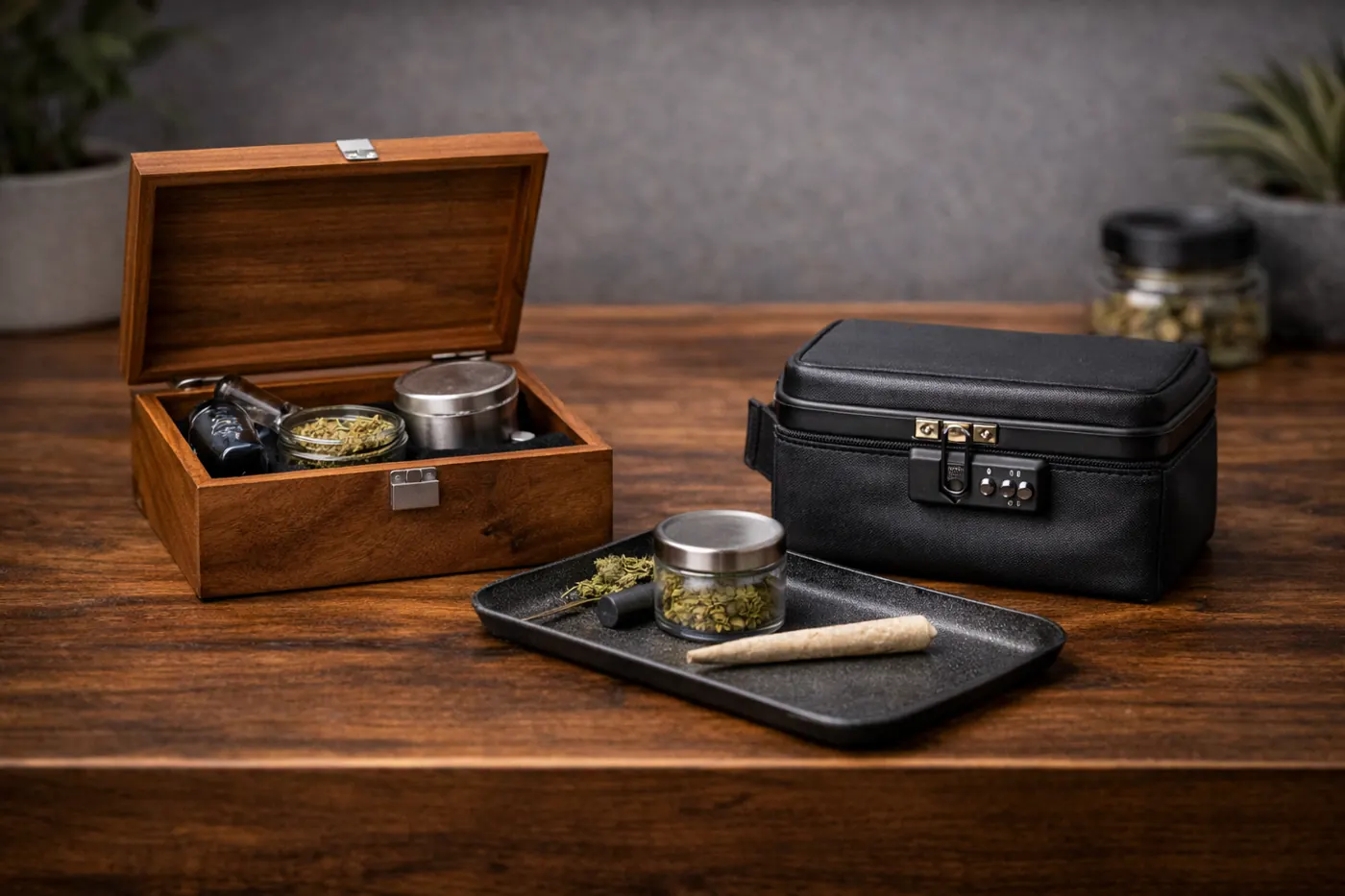
A smell-proof bag and a stash box can both make a cannabis setup cleaner, but they solve different problems. A bag is better when you need something portable, flexible, and easy to hide in a drawer or weekend bag. A stash box is better when you want a fixed home base for flower, a grinder, papers, cleaning tools, and small accessories.
The best choice depends less on which one sounds more discreet and more on where the setup actually lives: a bedroom drawer, a shared apartment, a closet shelf, a travel backpack, or a nightstand.
Quick answer
Choose a smell-proof bag if portability, soft-sided storage, and easy drawer storage matter most. Choose a stash box if you want a cleaner home base with compartments and less loose gear. Many adults eventually use both: a small smell-proof bag for travel or daily carry and a box or drawer setup for everything that stays at home.
At-a-glance comparison
| Storage type | Best for | Main advantage | Main tradeoff |
|---|---|---|---|
| Smell-proof bag | Travel, drawers, apartments, quick storage | Portable and easy to tuck away | Can become a clutter pouch if it has no structure |
| Stash box | Home base, nightstand, closet shelf, organized setups | Better separation for tools and accessories | Less portable and more visible |
| Airtight jar or container | Flower storage inside another setup | Simple odor control for one item | Does not organize the full routine |
When a smell-proof bag makes more sense
A smell-proof bag is the better pick when the setup moves around. It works for a weekend bag, a glovebox-style organizer where legal, a desk drawer, or a closet shelf where you do not want a hard box taking up space.
Look for a size that fits the actual routine: flower container, grinder, lighter or charging cable, and one or two small tools. Oversized bags sound useful, but they often turn into a loose pile of accessories. Smaller is usually better if discretion and daily reset are the goal.
When a stash box is the cleaner choice
A stash box makes sense when you want one stable home base. It is better for people who keep a grinder, cleaning brush, small containers, papers, charger, and backup parts in one place. Compartments matter more than the box looking expensive.
The tradeoff is visibility. A hard box on a shelf or nightstand is easier to notice than a soft pouch in a drawer. If you live with roommates, guests, or kids in the home, a lockable design and a less obvious storage spot matter more than the box itself.
What about odor control?
Neither option is magic. Smell control still depends on how well the main flower container seals, how often you clean residue-heavy tools, and whether used accessories are stored separately from clean ones.
Carbon-lined bags can help with everyday odor, but the zipper and seams still matter. Stash boxes can feel cleaner, but they usually need airtight jars or containers inside the box to do the real odor work.
Best setup for apartments and shared spaces
For apartment living, the safest routine is usually layered: flower in an airtight container, container inside a smell-proof bag or box, and tools kept in a tray or small organizer so residue does not spread. This keeps the setup from becoming a drawer full of loose gear.
If the storage spot is visible, choose something plain and adult-looking. If it is hidden, choose function first: easy closure, wipeable lining, real compartments, and a size you will actually reset after use.
Best setup for travel
For travel, a smell-proof bag usually wins. It packs flatter, handles small accessories better, and does not take over a backpack. A small hard case can be useful for a vaporizer or glass piece, but the main storage container should be compact enough that you are not tempted to overpack.
Keep the travel kit separate from the home kit if you can. That way you are not constantly emptying the same box or leaving parts behind.
Common mistakes
- Buying too large: bigger storage often creates more clutter, not more organization.
- Relying on the outer bag only: flower still needs a proper sealed container.
- Ignoring cleaning: grinders, brushes, and mouthpieces can carry odor even when flower is sealed.
- Choosing novelty styling: plain, boring storage usually looks better in an adult home.
What people tend to learn after owning both
A recurring theme in owner discussions is that bags and boxes are not true substitutes. They solve different annoyances. A smell-proof bag is better when the setup moves, needs to disappear quickly, or has to fit into a drawer or weekend bag. A stash box is better when the real problem is loose accessories: grinder, papers, brush, small containers, charger, screens, and whatever else keeps ending up on the nightstand.
Buyers often seem happiest when they stop asking which one is “more smell-proof” in the abstract and start asking where the gear actually lives. If the answer is “mostly at home,” a box or drawer organizer is easier to keep neat. If the answer is “sometimes home, sometimes travel,” a bag usually earns its keep.
What owners usually notice first
The bag feels more discreet right away because it can be tucked away. The box feels more organized right away because everything has a place. The first disappointment with a bag is often that it becomes a soft junk drawer. The first disappointment with a box is that it is more visible and less flexible than expected.
What starts to annoy people later
With bags, the later annoyance is usually zipper strain, crushed contents, and mixed clean/dirty items. With boxes, it is size, visibility, and compartments that do not fit the actual tools. A beautiful stash box can still be annoying if it cannot hold the grinder you already own or if it forces tall items to lie sideways.
The most common regret
The most common regret is buying for the fantasy setup instead of the real one. Product photos show neat jars and perfectly aligned accessories. Real setups include oddly shaped grinders, sticky tools, half-used cleaning packs, charging cables, and items you want separated. Measure the biggest pieces first and buy for those, not for the cleanest-looking photo.
What is worth paying more for
For bags, pay more for the closure, lining, zipper feel, and enough capacity to close without forcing it. For boxes, pay more for a sensible layout, stable hinges or lid, useful compartments, and a size that fits your shelf or drawer. Locks are useful for access control, but they do not replace discretion, legality awareness, or responsible storage.
Best fit, skip it, and setup reality
| Choice | Best fit | Skip it if | Setup reality |
|---|---|---|---|
| Smell-proof bag | Travel, small apartments, drawer storage, flexible routines | You want every tool separated and easy to see | Works best with an inner container and a light packing habit |
| Stash box | Home base, nightstand, closet shelf, organized daily use | You need something that moves with you often | Works best when the compartments match the gear you already own |
| Both | Adults with a home setup and a smaller go-bag | You are trying to keep the setup minimal at all costs | Use the box as the base and the bag as the travel kit |
The GreenGiggles take
For most adults, the best answer is not bag or box forever. It is bag for movement, box for home, and airtight containers for the items that actually smell. Start with the place that causes the most friction. If your drawer is messy, a box or organizer helps. If your kit travels, a smell-proof bag is the better first buy.
Disclosure: This page may contain affiliate links, which means GreenGiggles may earn a commission if you buy through them, at no extra cost to you.
Questions that come up when choosing between a bag and a box
These questions focus on smell proof bags stash boxes from an ownership angle: what tends to work at first, what gets annoying later, and where buyers should be careful before adding more gear.
Is a smell-proof bag better than a stash box?
Neither is automatically better. Bags usually win for travel, closets, backpacks, and flexible storage. Stash boxes usually win for a fixed home base, better organization, and a cleaner nightstand or drawer routine.
Is airtight the same as smell-proof?
Not exactly. Airtight storage can help contain odor around the item itself, but smell-proof bags and cases are usually about a full setup: lining, closure, seams, and how the gear is packed. Airtight containers inside a bag or box can be stronger than either approach alone.
What is the most common regret?
The most common regret is choosing the format that looks better online instead of the one that fits the routine. A beautiful stash box is annoying if you need to move gear around. A soft bag is annoying if you want a stable, organized home station.
What should go inside each setup?
A bag should hold only what needs to travel or stay contained. A box can handle the home routine: grinder, container, lighter or charger, screens, small brush, and maybe a compact tray. Loose dirty tools are what make either setup feel worse over time.